
ESTA and US Visas: Who Needs What
Who needs an ESTA and who needs a US visa: the 42 Visa Waiver countries, the current $40.27 fee, the 90-day limit and what cancels eligibility.

If your passport comes from one of the 42 Visa Waiver Program countries, you need an ESTA: $40.27, valid for two years, applied for online, usually approved in minutes. Citizens of Canada and Bermuda generally need neither an ESTA nor a visa for a visit, though Canadians who drive in without an I-94 and stay 30 days or more must also register with USCIS. Nearly everybody else needs a visa, which for tourism means a B-2, an application fee of $185 and an interview at a US embassy or consulate. On top of that, HR-1 - the 2025 reconciliation law - added a $250 visa integrity fee, charged when a visa is issued, and the statute says it can’t be waived or reduced. The State Department hasn’t folded it into its published fee tables yet, so confirm the current total with the consulate handling your application. The gap between those two experiences is measured in weeks, so it’s worth knowing which side you’re on before you book anything.
Romania is the reason to check rather than assume. It was designated into the Visa Waiver Program on 9 January 2025, Romanian travelers started planning around it, and the designation was rescinded on 2 May 2025 before it was ever implemented. Nobody ever flew on it. Lists move in both directions, and the only one that counts is the one the Department of Homeland Security is publishing on the day you travel.
ESTA or visa: the practical difference
| ESTA (Visa Waiver Program) | B-1/B-2 visitor visa | |
|---|---|---|
| Who it is for | Citizens of the 42 VWP countries | Most other passports, and anyone VWP-ineligible |
| Cost | $40.27 | $185 application fee, plus a $250 visa integrity fee at issuance under HR-1 - confirm with your consulate |
| How you apply | Online form, no interview | Online form plus in-person interview |
| Typical wait | Minutes to 72 hours | Weeks to months, by consulate |
| Validity | 2 years, or until the passport expires | Up to 10 years |
| Maximum stay | 90 days | Up to 6 months per admission |
| Can you extend? | No | Yes, generally |
| Can you change status? | No | Yes, generally |
This is general information for travelers, not legal advice. Entry rules, fees and country lists change, sometimes at short notice and sometimes with immediate effect. Before you book and again before you fly, check the official sources: travel.state.gov for visas and cbp.gov/esta for the Visa Waiver Program. If your situation is complicated, talk to an immigration attorney rather than a travel site.
The 42 countries
The current list covers most of western Europe plus a scattering of others: Andorra, Australia, Austria, Belgium, Brunei, Chile, Croatia, Czech Republic, Denmark, Estonia, Finland, France, Germany, Greece, Hungary, Iceland, Ireland, Israel, Italy, Japan, South Korea, Latvia, Liechtenstein, Lithuania, Luxembourg, Malta, Monaco, the Netherlands, New Zealand, Norway, Poland, Portugal, Qatar, San Marino, Singapore, Slovakia, Slovenia, Spain, Sweden, Switzerland, Taiwan and the United Kingdom.
Three of those entries carry conditions that catch real people every year.
The United Kingdom entry means British citizens with unrestricted right of abode in the UK. British Overseas Citizens, British Overseas Territories citizens and citizens of Commonwealth countries holding British-style documents aren’t covered, and they need a visa unless another exemption applies, as it does for citizens of Bermuda whose passport carries a Bermudian status stamp.
The Netherlands entry does not extend to passports issued by Curacao, Bonaire, St Eustatius, Saba or St Maarten. If that is the passport you present, the Visa Waiver Program is not available to you.
Taiwan covers people with unrestricted right of permanent abode in Taiwan holding an electronic passport that shows a household registration number.

Two countries used to be on the list and are not: Argentina, removed in 2002, and Uruguay, removed in 2003. Designation is reviewed at least every two years, and DHS can suspend a country immediately if it decides there’s an urgent threat.
What an ESTA costs now, and when to apply
The fee is $40.27 per traveler for fiscal year 2026, and CBP started charging that amount on 1 January 2026. It isn’t a round number because part of it is indexed to inflation: $17 plus a cost-recovery component that rose to $10.27 plus a $13 element written into the 2025 reconciliation law. If your application is denied, you still pay the $10.27 cost-recovery portion.
An approved authorization is generally good for two years, or until your passport expires, whichever comes first. New passport means new ESTA, even if the old one has time left on it.
CBP’s own advice is to apply as soon as you start planning, or at least before you buy tickets. That’s better advice than the “72 hours” figure that floats around travel forums, for a good reason: most applications clear in minutes, but a small share go to manual review, and if yours is one of them, you’ll find out at the airport when the airline refuses to board you. Airlines check the authorization before departure. An ESTA applied for the night before is a bet on the fast path.
Apply on the official site, esta.cbp.dhs.gov, and nowhere else. A crowd of copycat sites fill in the same form for you and charge three or four times the government fee for the privilege.
What cancels your eligibility
Eligibility can vanish for reasons that have nothing to do with your own conduct.
Travel history. If you have been present in Iraq, North Korea, Syria, Iran, Sudan, Libya, Somalia or Yemen at any time on or after 1 March 2011, you are no longer eligible to enter under the Visa Waiver Program. Cuba was added separately: a visit on or after 12 January 2021, the date it was designated a State Sponsor of Terrorism, has the same effect.
Dual nationality. If you hold citizenship of a VWP country and also of Iraq, Syria, Iran, North Korea or Sudan, you cannot use the Visa Waiver Program regardless of where you have or have not traveled. The same applies to dual nationals of Cuba.
There are narrow exceptions to the travel restriction for people who were in those countries on military service for a VWP country’s armed forces, or on official duty as a full-time government employee. Carry documentation if that’s you. Critically, those exceptions do not apply to the dual nationality rule.
None of this bars you from the United States. It moves you into the visa line. If your ESTA is refused or revoked and you have urgent business, medical or humanitarian travel, you can request an expedited visa appointment. Build in weeks, not days.
Ninety days means ninety days
The Visa Waiver Program allows a maximum of 90 days per admission, and that number does not stretch. You can’t apply to extend it once you’re in the country, and you can’t switch to a student or work status from inside. If your plans might run past three months, or might change while you are there, the B-2 visa is the better instrument even though it costs more and takes longer. It typically admits you for up to six months, and it can generally be extended.
One more thing that is widely misunderstood: an approved ESTA is permission to board a plane, not permission to enter the country. Admissibility is decided by a CBP officer at the port of entry, after you land. That decision is theirs, and the Visa Waiver Program gives you far less room to contest it than a visa does. Have your return ticket, your accommodation address and a straight answer to “what are you here for” ready. Officers ask, and vagueness is what turns a two-minute conversation into a two-hour one.
Passports, and the one date that matters
Since 1 April 2016, every Visa Waiver traveler must hold an e-passport: the one with the little gold camera-shaped chip symbol on the cover and a machine-readable zone on the photo page. No chip, no ESTA, whatever your nationality. Passports issued in the last decade almost always qualify, but if you’re traveling on an older document, check the cover before you check anything else.
Driving in from Canada or Mexico
Land arrivals aren’t a loophole. Since October 2022, VWP travelers arriving by land have needed the same pre-travel authorization as anyone flying, so an ESTA is required at the border booth in Blaine or Buffalo just as it is at JFK.
Land crossings carry one extra cost that air passengers never see: the Form I-94 arrival record. For fiscal year 2026 it totals $30 at a land border, made up of a $6 land border fee and a $24 statutory fee. Arrive by air or sea and there’s no I-94 fee at all, because you are not required to apply for the form.

A short pre-trip check
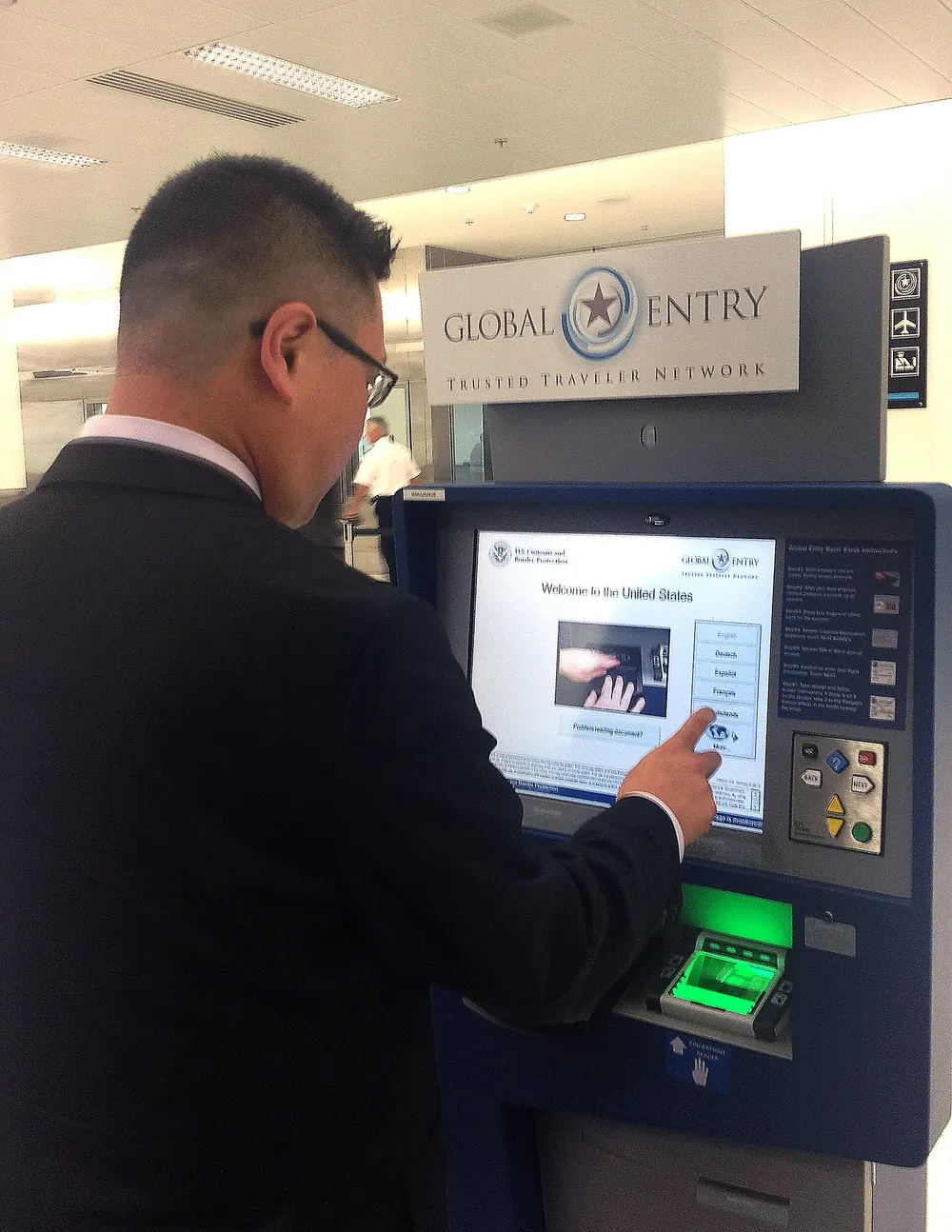
Six weeks out, look at four things: the chip symbol on your passport cover, the expiry date, whether your country is still on the DHS list, and whether anything in your travel history or nationality puts you in the visa group. If all four are clean, the ESTA takes ten minutes and you’re on to the interesting decisions, like when to go and what the trip will cost. Global Entry and TSA PreCheck is a separate form after that, and only if CBP’s country list actually includes your passport.
If any of them isn’t clean, start the visa process now. Consular wait times vary enormously by city and season, and no amount of planning at the US end will compress them.
Once you clear the passport booth there is one more counter waiting, and it has its own rulebook about food, cash and medication: our guide to US entry and customs covers what you can actually carry in.
Read also
- Next stop after immigration: US entry and customs: what you can bring
- Pick your season: best time to visit the USA
- Budget the trip: how much does a USA trip cost
- Landing in New York: things to do in New York City
Good to know
Fees and eligibility rules in this guide were checked against travel.state.gov, cbp.gov, dhs.gov and the Federal Register on 24 July 2026. Immigration rules change without much warning - confirm on the official source before you book and again before you fly.
Details checked: July 24, 2026
Read also

Before you go · 9 min read
New England Fall Foliage: When and Where to Go
Verified · August 27, 2026Yankee's 2026 forecast, peak windows by state and how to chase color from Vermont's Northeast Kingdom to the NH coast without betting on one weekend.

Before you go · 9 min read
Which Hawaiian Island: Oahu, Maui, Kauai or Big Island
Verified · August 24, 2026Pick one Hawaiian island for a week: Oahu for city and surf, Maui for beaches and Haleakala, Kauai for scenery, Big Island for volcanoes.

Before you go · 11 min read
Where to Stay in Phoenix: Downtown, Scottsdale or Tempe
Verified · August 18, 2026Free Sky Train, then $2 light rail into downtown. Scottsdale is the resort city; Tempe is ASU next door. Phoenix hotel tax is 13.07%.

Before you go · 11 min read
Global Entry and TSA PreCheck for Visitors
Verified · August 15, 2026Global Entry is $120 for five years and closed to most EU passports. TSA PreCheck is $85 or less, and only US citizens and LPRs can buy it.